

Designed for directors, executives, investors, and everyone who wants ethics to inform board decisions, this guide turns ethical oversight from an abstract aspiration into a concrete set of practices.
Executive Summary
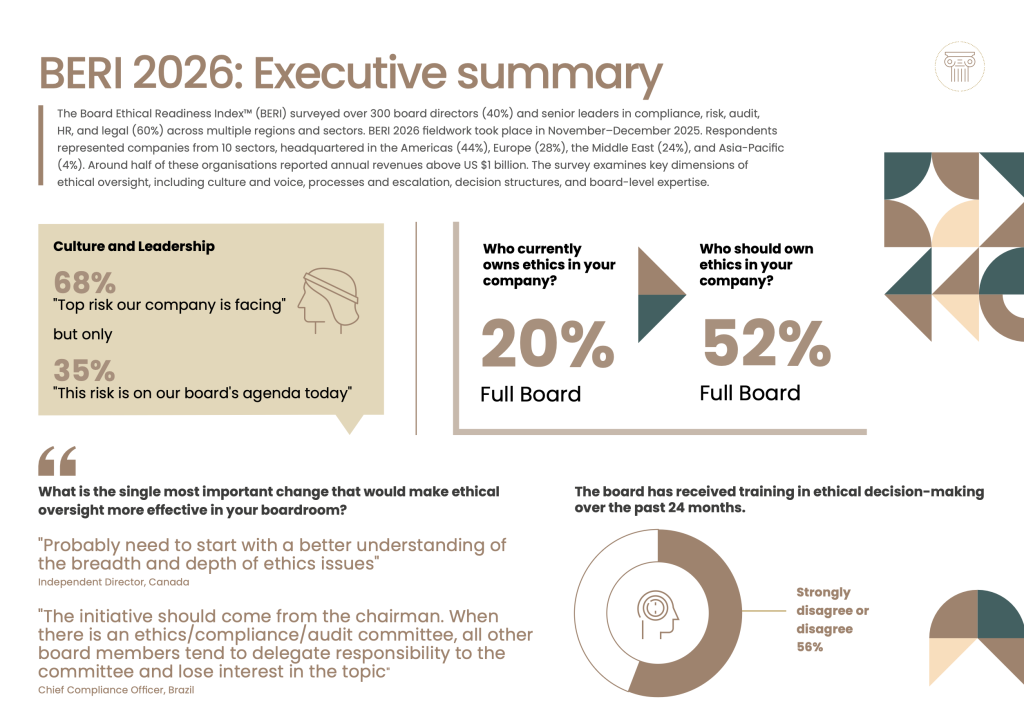
Ethics must evolve from a nice-to-have add-on to governance into a core operating system for modern boards. Polycrisis, technological shocks, leadership misconduct, and geopolitical whiplash – the same forces that make corporate life so volatile today are the ones exposing how thin many boards’ ethical oversight is. Our research indicates that while directors recognise culture, conduct, and trust as core foundations of enterprise value, they lack a practical way to oversee them. The How Boards Should Oversee Ethics guide responds to that gap. This summary distils ten concrete practices to help boards bring ethics into the centre of strategy, risk, and performance conversations.
Ask Better Questions
One of the most underappreciated skills in governance is learning to formulate the right question in the right way, a skill philosophers treat as a form of art. A well-framed question can unlock an entire field of insight. But far too many boards today suffer from FOFO, or the fear of finding out. Good questions are rarely asked. And even when they are, boards sometimes prefer to ignore the answers, or settle for rehearsed, sanitised responses they never follow through on. A related trap is FOMO, the fear of missing out: the rush to act quickly to look decisive, even when the harder work is to understand causes and improve systems. Curiosity requires courage and the willingness to notice when an explanation doesn’t add up. The lack of both is where many, if not most, corporate scandals of the past two decades originated.
Oversee Culture — Starting with Your Board’s Own
Whether or not Peter Drucker really said that culture eats strategy for breakfast, corporate culture has clearly moved from an intangible, feel-good concept to a measurable, strategic asset, a critical risk multiplier or mitigator. When it comes to measuring and assessing culture, there’s a shared recognition that it needs to go beyond the basic engagement survey, with other data points, narrative reporting, and board members “walking the floor.” Boards can no longer afford to treat culture as a soft issue or delegate it entirely to management. Multiple governance guidelines call for the board’s active role in fostering an organisation’s culture, but the best starting point is to examine its own culture first, as it tangibly affects how directors raise, discuss, and resolve issues.
Look Beyond the Numbers
The idea that “numbers are gods” can be traced back to Pythagoras, and modern corporations have taken it literally. Modern management has been swallowed by “arithmocracy”, a system in which power resides in numbers and those who control them. Yet if so many boards are filled with financial experts, why do companies still collapse? One reason is that many of today’s most consequential risks sit outside the financial statements, until they don’t. And while the case for accounting for what’s observable and known is clear, change is slow. That’s why the accompanying narrative, or the “why” behind the numbers, matters more than ever. In the end, every board debate starts with figures but ends with values and consequences. A board can have all the data in the world, yet the final call still rests on judgment and conscience.
Practice Ethical Foresight
In an environment of polycrisis and persistent uncertainty, boards can add value by leveraging their diverse functional, generational, and life experiences — great resources for exploring possibilities not yet grounded in reality. However, boards are used to reviewing what went wrong, far less so to imagining what might. Hindsight tells us what happened; insight explains why; foresight anticipates how today’s choices could evolve; and oversight connects them all into a holistic picture. Ethical foresight, in particular, is moral imagination in practice: the ability to trace a decision into the future and ask, If the context changes, will it still be right? Call it a premortem or a blue-sky discussion, the skill offers a useful lens for improving decision quality. Many corporate failures were entirely predictable to those willing to look a few practices ahead.
Debate Well
Boards are collectives. Each director brings a decision-making style formed by experience, risk fingerprint, and social conditioning to the table. Each also influences and is influenced by the group. Power dynamics exist in every boardroom: they can be healthy, with flexible, balanced influence, or unhealthy when power becomes concentrated and rigid. Ethics in the boardroom is therefore a practice of group decision-making, strengthened by reflection on how power is exercised and by principled, evidence-based disagreement. Boards cease to perform their proper function if a concern for collegiality gives way to ‘group-think’ and “we’ve always done it that way” becomes a substitute for reasoning. Debating well means deliberately making room for dissent, resisting the instinct for self-protection. It means challenging your own logic as rigorously as management’s.
Cultivate Character
Leadership science loves new labels, but the underlying virtues haven’t changed much in two thousand years. What the Romans called gravitas — a mix of integrity, humility, prudence, and moral weight – we now call executive presence, judgment, and emotional intelligence. Character, as much as these dimensions, is not given at birth but individually and uniquely developed within the context of life. Like a muscle, it strengthens with practice and weakens with neglect. Directors perform best when traits are in balance: too little integrity becomes untruthfulness; too much can become rigidity and dogmatism. Ethics is not a one-time “personal conscience test.” It is a discipline of character applied in context, where personal traits must be balanced with organisational and societal values. Arguably, we live in times when a leader’s character is as important as their competence.
Set the Conditions for Speak-Up
Some directors say that internal auditors are their best friends. That might be true, but whistleblowers can be even more valuable. Ideally, boards should appoint a non-executive director as a whistleblowing champion and keep a close eye on reporting data and trends. Too few reports can be as concerning as too many. Fear and futility remain the biggest obstacles to speaking up. Yet in the rush to build “psychological safety,” many companies have created its opposite: artificial harmony where everyone’s nice but no one is honest. Real safety requires intent and systems that make truth-telling possible and survivable. Think of Toyota’s Andon Cord: anyone could pull it, regardless of status. Boards should be tasking management to build equivalent mechanisms, bearing in mind that every interaction with the whistleblower counts, from the first line manager to the board.
Recruit for Independence; Pay for Conduct
There is a growing consensus that ethical conduct should be reflected in executive pay, yet many compensation committees still underutilise this toolbox. Conduct and risk should be explicitly considered whenever the committee signs off on variable pay or vesting outcomes. If a substantial ethical breach occurs, pay should not vest—and, if it already has, it should be subject to a malus and clawback. Ethics clauses should not be limited to executive contracts but also be included in directors’ service terms or equivalent board documentation, with clear expectations and consequences defined in advance.
Using compensation as an ethical lever presupposes that directors are genuinely independent. Independence is not primarily a structural status; it is a mindset. Too many directors and chairs are appointed on the basis of pre-existing relationships or profile. They may be experienced and well-connected, yet still out of their depth on the business, or too beholden to those who supported their appointment to challenge them. When directors owe their positions to extra-boardroom loyalties, whether to fellow directors, investors, or management, independence becomes lip service. Only when a director is both competent and independent in thinking can they credibly challenge.
Bring in the Right Expertise
If your board doesn’t yet include a director with ethics, risk, and compliance expertise, add one, or start with interim mechanisms such as regular executive sessions, an advisory board member, or a board apprentice. The case is clear. Chief Ethics, Risk, and Compliance Officers bring integrated risk thinking, cultural stewardship, stakeholder trust, and oversight of leaders’ conduct – capabilities that boards need to navigate today’s complexity. This isn’t about diversity for its own sake. Rather, modern problems require modern solutions, as a popular saying goes. Adding ethics, risk, and compliance expertise to the board aligns board composition with the realities of the risk boards and the organisations they serve are currently facing.
Practice Stewardship
There’s a persistent belief that directors have a legal duty to maximise corporate profits and “shareholder value,” even if that means bending ethical norms. That is an oversimplification. First, what actually drives short-termism is not the law itself, but impatient capital that profits from short-term price moves, and modern executive compensation practices tied to annual returns. Second, corporate law is intentionally designed so courts rarely second-guess business judgments. The business judgment rule gives boards wide latitude, as long as decisions are informed, made in good faith, and reasonably believed to serve the corporation’s best interests. Third, some scholars go further to argue that directors are better described as “discretionaries” than pure fiduciaries: people given wide discretion whose liability is, in practice, limited. The central question then becomes: what do boards choose to do with that discretion?
All of that means that boards cannot outsource ethics to judges or regulators. The earlier practices in this Guide are the tools: curiosity, culture, numbers, foresight, debate, character, room for dissent, incentives, and ethics expertise. Stewardship is the test of how boards use them.
A Ten-Practice Guide
- Ask Better Questions
- Oversee Culture — Starting with the Board’s Own
- Look Beyond the Numbers
- Practice Ethical Foresight
- Debate Well
- Cultivate Character
- Set the Conditions for Speak-Up
- Recruit for Independence; Pay for Conduct
- Bring in the Right Expertise
- Practice Stewardship
Click here to access the complete guide
Article: Vera Cherepanova – Executive Director, Boards of the Future
Disclaimer: The views and opinions expressed in the articles are those of the author(s) and do not necessarily reflect the official stance of the Ethics and Reputation Society.