
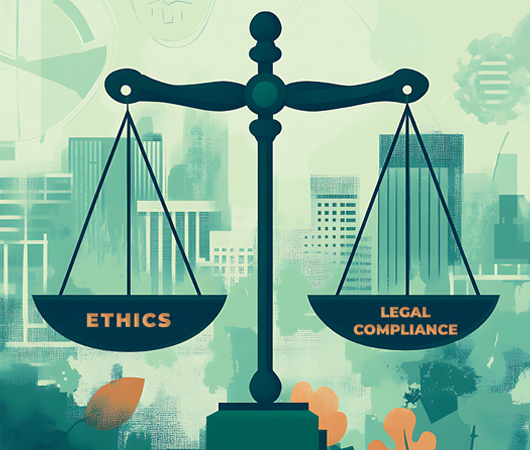
Dawn raids – unannounced inspections by competition authorities – are among the most intrusive enforcement tools in antitrust law. They place companies under immediate pressure, testing not only their legal preparedness but also their ethical resilience. While the law provides a framework of minimum obligations, ethical conduct can shape outcomes of an investigation as decisively as legal compliance.
Importantly, ethics is a two-way street. It does not apply solely to companies; Competition Authorities are equally bound by principles of fairness, transparency, and respect for rights. Competition Authorities must ensure accurate documentation, proportionality in evidence gathering, and adherence to the scope of their mandate. The Intermarché case illustrates this vividly: the European Commission’s failure to properly record supplier interviews was not only a procedural flaw but also can be considered as an ethical lapse that ultimately led to annulment of the dawn raids.
This article examines the anatomy of a dawn raid through three interconnected lenses: judicial expectations, the interplay between ethics and legal compliance, and practical strategies for operationalizing integrity under pressure. It also explores the evolving situation in Türkiye, where frequent inspections coexist with constitutional challenges and digital privacy dilemmas.
All of these create a complex enforcement landscape that companies – and Competition Authorities – must navigate with both caution and foresight.
1. Dawn Raids in EU Competition Enforcement
Under Regulation 1/2003[1], the European Commission holds extensive powers to conduct on-site inspections aimed at uncovering evidence of antitrust violations. These dawn raids allow officials to enter business premises without prior notice, review documents, and copy data, often creating intense pressure for companies. National competition authorities across the EU exercise similar powers under their respective laws.
Yet these powers are not without limits. Courts have consistently emphasized that dawn raids must respect fundamental rights and adhere to strict procedural standards. Proportionality, scope discipline, and rigorous documentation are essential safeguards. A dawn raid cannot serve as a fishing expedition; it must be grounded in solid factual evidence and executed within the boundaries of the investigation’s stated purpose, and there are much we strict safeguards in place.
Recent case law developments support these principles. The Intermarché and Casino[2] decisions have become a landmark in the evolution of dawn raid jurisprudence within the EU. In 2017, the European Commission carried out unannounced inspections at the premises of French retailers Casino and Intermarché, suspecting infringements of Article 101 TFEU. These raids were part of a broader investigation into alleged collusion in the grocery retail sector.
However, the legal trajectory of this case illustrates how procedural rigor – and its ethical underpinnings – can determine the fate of enforcement actions. By 2020, the General Court partially annulled the inspection decisions, highlighting procedural flaws and reminding the Commission that its investigative powers, while extensive, are not without limits. The decisive moment came in 2023, when the CJEU went further and fully annulled the dawnraids. The reason for such annulment: the Commission had relied on supplier interviews that were neither properly recorded nor validated. Internal notes were deemed insufficient to justify such an intrusive measure.
This judgment clarified key judicial expectations. Inspections must rest on a solid factual basis – dawn raids cannot be launched on mere suspicion or as fishing expeditions. Evidence gathering must meet high standards of accuracy and transparency; interviews must be documented and confirmed by the interviewees. Finally, proportionality and scope discipline are essential: authorities must stick to the articulated theory of harm and avoid overreach.
The annulments underscore a critical lesson: procedural discipline is not a technicality but a safeguard of fundamental rights. Ethical lapses in the collection of evidence – such as failing to properly record interviews – can translate into legal defects, ultimately collapsing an entire investigation. For companies, this case serves as a reminder that meticulous documentation and respect for due process are not only defensive strategies but may be considered also as ethical imperatives.
2. Dawn Raids in Türkiye: Legal Uncertainty and Expanding Practice
Türkiye stands out for the intensity of its enforcement activity. The Turkish Competition Authority continues to conduct frequent on – site inspections, a fact that often surprises international practitioners. In 2024 alone, the TCA carried out more than 250 dawn raids, deploying over 1,000 case handlers – a scale that underscores its commitment to aggressive investigative tools.
Yet, the future of dawn raids in Türkiye is now clouded by legal uncertainty. Following the Constitutional Court’s landmark Ford decision, the Court ruled that the TCA must obtain judicial authorization before conducting on – site inspections. This judgment strengthens procedural safeguards but also casts doubt on the legality of past raids. Although the ruling arose from an individual application and does not yet have general effect, it establishes a principle: dawn raids without a judge’s order are unconstitutional.
The matter remains on the Constitutional Court’s agenda under its concrete norm control procedure, and legislative reform is expected. Ultimately, Parliament will need to amend the Competition Law[3] to align with constitutional requirements. For now, however, no immediate legislative action has been taken, and inspections continue in practice. Companies challenging TCA decisions increasingly argue that the underlying raids were unlawful, and at least one Board member regularly casts a dissenting vote against dawn raid decisions.
This legal ambiguity coincides with ethical and practical challenges. Inspectors routinely review digital data, including WhatsApp messages, on devices used for business purposes. While this approach aims to uncover hidden communications, it raises concerns about privacy and proportionality. Employees often panic and delete messages – a reaction that can lead to obstruction fines of up to 0.5% of annual turnover. Ethical safeguards such as clear pre – raid briefings, data minimization protocols, and respect for personal information are essential to prevent such outcomes.
In short, Türkiye today presents a paradox: an authority conducting some of the highest numbers of dawn raids globally, while the constitutional foundation of those raids is under challenge. Until legislative reform resolves this tension, companies must navigate a dual reality – cooperating with inspections as they occur, while preserving their rights and documenting objections. At the same time, ethical conduct remains critical, both to protect individuals and to maintain credibility in an enforcement environment that is increasingly complex and interconnected.
3. Ethics vs. Legal Compliance
- The law sets the floor; ethics sets the bar.
During a dawn raid, legal obligations define what companies must do to avoid penalties – allowing inspectors access, preserving evidence, refraining from obstruction, and managing privilege claims correctly. These requirements are essential, but they represent only the minimum standard.
Ethical responsibilities go further. They demand integrity in how evidence is preserved, ensuring transparency and organized cooperation rather than mere compliance. They call for data minimization, protecting personal or sensitive information that is irrelevant to the investigation, and applying proportionate redactions instead of blanket privilege claims. They also require truthfulness – providing clear and accurate answers rather than technically correct but evasive responses or exploiting procedural grey zones to delay the process.
Why does this matter? Because ethics is not just about doing the right thing; it is a strategic advantage. Ethical conduct builds credibility with authorities, may reduce litigation risk, and protects employees’ dignity during what is often a stressful and invasive process. It fosters a compliance culture that goes beyond “check – the – box” obligations and demonstrates a commitment to fairness and transparency.
In practice, this means companies should act proactively: issuing immediate “no deletion” instructions, briefing employees on their roles and rights, and supervising forensic processes to ensure respect for privacy. It also means avoiding tactics that, while technically legal, undermine trust – such as over – claiming privilege or delaying searches. Ethics and compliance are not separate tracks; they are intertwined, and together they shape outcomes.
- Ethics is a Two-Way Street
Ethical standards in dawn raids do not apply solely to companies – they bind authorities as well. Enforcement agencies are expected to uphold fairness, transparency, and respect for rights throughout the inspection process. This includes accurate documentation of interviews, proportionality in evidence gathering, and adherence to the scope of the investigation. The Intermarché case illustrates this vividly: the Commission’s failure to properly record supplier interviews was not only a procedural flaw but an ethical lapse in truth-tracking, ultimately leading to annulment of the raids.
For companies, ethics elevates compliance from “not obstructing” to actively safeguarding integrity, people, and due process. In practice, this means providing clear and accurate answers rather than technically correct but evasive ones; protecting dignity through non-retaliation and whistleblower safety; applying genuine data minimization by segregating personal information and explaining proportionate redactions; and avoiding grey-zone tactics such as unnecessary delays or tactical privilege claims. Ethical behavior also extends to transparent briefings so employees understand their roles and support channels, and post-raid aftercare through blameless reviews and shared learnings.
The contrast is clear: conduct that is both legal and ethical – such as immediate preservation of chats and emails, full request-response logs, – builds trust. “Legal but unethical” actions, like keyword gaming or blanket privilege claims, erode credibility, while unlawful and unethical acts – such as deleting messages or hiding devices – invite severe sanctions. Operationalizing ethics requires tone from the top, robust training, clear escalation maps, and disciplined after-action reviews. When both companies and authorities embrace these principles, dawn raids become not only a compliance exercise but a demonstration of integrity on both sides.
- Understanding the Human Factor in Obstruction
Not all instances of obstruction during dawn raids stem from an intent to conceal competition law infringements. Sometimes, employees hesitate to grant access to certain communications for reasons unrelated to antitrust concerns. For example, a WhatsApp group might contain sensitive discussions among staff documenting workplace harassment or other internal issues they fear could be exposed to their superiors. In such cases, resistance is driven by personal protection rather than corporate misconduct.
This reality underscores the importance of clear communication and confidentiality assurances from authorities. Employees should be informed that data collection will be limited to information relevant to the investigation and that personal or sensitive content will be handled with discretion. Guaranteeing confidentiality and applying robust data minimization principles can reduce anxiety, prevent panic-driven deletions, and foster cooperation. Ethical enforcement, therefore, requires not only procedural rigor but also empathy for the individuals involved – balancing investigative needs with respect for privacy and dignity.
In the 2020 Intermarché ruling, the General Court also stressed that inspected companies are legitimate asking inspectors to take appropriate measures to protect the private data of their employees and they can go the Court based on urgency proceedings if they believe insufficient protections have been granted.
[1] E.g. Council Regulation (EC) No 1/2003, Article 20.
[2] Case T – 255/17 and C – 693/20 P, Intermarché & Casino v Commission.
[3] Law No. 4054 on the Protection of Competition
Article: Dr. Mehmet Fevzi Toksoy – Partner, ACTECON Consulting,
Nathalie Jalabert-Doury – Partner at Mayer Brown Paris
Source: INmagazine No. 40
For Other Issues: INmagazine
Disclaimer: The views and opinions expressed in the articles are those of the author(s) and do not necessarily reflect the official stance of the Ethics and Reputation Society.